Plant diseases

How does the lack of agricultural diversification contribute to vulnerability in the sector?

sector

Overdependence on a Single Crop or animal: Farmers become excessively dependent on the productivity and market dynamics of a single crop or animal species. Any unfavorable occurrences, like pests, illnesses, market swings, and unfavorable weather, can have a huge effect on the overall sector. Economic instability in the agriculture sector and significant income losses for farmers might result from a single crop failure or a drop in demand.

Market Volatility and pricing variations: Farmers may be more vulnerable to market volatility and pricing variations if they lack diversity. Farmers are more susceptible to changes in supply and demand dynamics, global market trends, and price volatility when they produce and rely on a small number of commodities.

Climate change adaptation: The effects of climate change on agriculture include changes in temperature and precipitation patterns, a rise in the frequency of extreme weather events, and altered dynamics of pests and diseases. Growing crops that are more tolerant to particular conditions thanks to crop diversification enables farmers to respond to these difficulties. Farmers can distribute risk and lessen sensitivity to climate-related effects by diversifying their agricultural methods.
What are the latest developments in agricultural trade and tariffs?

tariffs

I can give you some general information on the most recent changes in agricultural trade and tariffs up to my knowledge cutoff in September 2021. Please keep in mind that the environment for agricultural commerce and tariffs is dynamic, so it’s best to check recent news sources or official government websites for the most latest details. Here are some current events and trends that were significant during the time.

Trade disagreements between the main agricultural trading partners were still present. For instance, a trade war between the United States and China resulted in tariffs being placed on a variety of goods, including agricultural supplies. Uncertainty and disruption of agricultural trade flows between the parties were caused by these disputes.

Tariff reductions and exemptions: In order to promote commerce, certain nations have implemented tariff reductions or exemptions. These actions attempted to increase agricultural exports and lessen the COVID-19 pandemic’s negative economic effects. To lower barriers and encourage agricultural commerce, governments were also establishing and upgrading preferential trade agreements.

How is machine learning used for predicting market demand in agriculture?

market demand

With the use of historical data, current market trends, and other pertinent variables, machine learning is increasingly being utilised to forecast market demand in agriculture. Here is an example of how machine learning is used to forecast market demand.

Data collection: Useful information is gathered, such as past sales figures, industry trends, seasonal patterns, consumer behaviour, and other variables that may affect market demand. This information can be found in a variety of places, including market research studies, governmental databases, and internal corporate files.

The selection of relevant characteristics is necessary for machine learning algorithms to produce reliable predictions. In order to pinpoint the factors that have the greatest influence, feature selection approaches are used. These aspects may include product characteristics, pricing details, marketing initiatives, seasonality, and outside variables like economic data.

Model Training: Using the preprocessed data, machine learning models are trained, including regression, decision trees, random forests, and neural networks. The patterns and connections between the input attributes and market demand are discovered by the models. The models modify their internal parameters during training in order to reduce prediction mistakes.

How are AI and machine learning used for predicting crop diseases?

The study and comprehension of plant features and their interactions with the environment have been completely transformed by advances in plant phenotyping technologies. The following are significant developments in plant phenotyping.

High-Throughput Phenotyping: In high-throughput phenotyping, numerous plant properties are quickly and non-destructively measured. Robotics, imaging platforms, sensors, and other automated systems are used to do this. These technologies can quickly collect data from hundreds or thousands of plants, allowing scientists to more precisely and quickly analyse plant properties. Breeding programmes, genetic research, and agricultural development initiatives have all been greatly enhanced by high-throughput phenotyping.

Imaging Technologies: Imaging technologies with sophisticated plant phenotyping capabilities include hyperspectral imaging, thermal imaging, and 3D imaging. By taking pictures in a variety of spectral bands, hyperspectral imaging enables the evaluation of plant biochemical composition, stress reactions, and disease identification. Plant stress can be identified via thermal imaging, and water use efficiency can be tracked. Detailed information on plant architecture, root development, and canopy structure is available thanks to 3D imaging. These imaging techniques offer insightful information about the characteristics of plants and how they react to their surroundings.

Non-Invasive Sensors: Non-invasive sensors that don’t injure or disturb plants, such spectrometers, fluorometers, and gas analyzers, are used to detect their varied physiological and biochemical characteristics. For instance, gas analyzers and chlorophyll fluorescence sensors can both evaluate photosynthetic efficiency and stress reactions.

What are the advancements in plant phenotyping technologies?

phenotyping

The study and comprehension of plant features and their interactions with the environment have been completely transformed by advances in plant phenotyping technologies. The following are significant developments in plant phenotyping.

High-Throughput Phenotyping: In high-throughput phenotyping, numerous plant properties are quickly and non-destructively measured. Robotics, imaging platforms, sensors, and other automated systems are used to do this. These technologies can quickly collect data from hundreds or thousands of plants, allowing scientists to more precisely and quickly analyse plant properties. Breeding programmes, genetic research, and agricultural development initiatives have all been greatly enhanced by high-throughput phenotyping.

Non-Invasive Sensors: Non-invasive sensors that don’t injure or disturb plants, such spectrometers, fluorometers, and gas analyzers, are used to detect their varied physiological and biochemical characteristics. For instance, gas analyzers can evaluate carbon absorption and transpiration rates, while chlorophyll fluorescence sensors can gauge photosynthetic effectiveness and stress responses. These sensors offer real-time information on plant health, functioning, and responses to external stimuli.

UAVs and Remote Sensing: The use of unmanned aerial vehicles (UAVs) and satellite pictures for remote sensing has greatly improved the ability to phenotype plants. Large-scale monitoring is possible thanks to satellite images, which also offers information on growth trends, crop health, and vegetation indices. High-resolution cameras or sensors on UAVs can gather precise and localised data on plant characteristics including biomass, leaf area, and crop.

How is hyperspectral imaging used for crop disease detection?

hyperspectral

Identification of Disease Symptoms: Hyperspectral imaging aids in the detection of diseases’ subtle effects on plant physiology and biochemistry. Hyperspectral imaging can identify illness symptoms that might not be obvious to the unaided eye by comparing the distinctive spectral fingerprints of healthy and diseased plants. This includes modifications to the leaf’s morphology, biochemistry, and colour and texture.

Early Disease Detection: Hyperspectral imaging makes it possible to identify diseases early, frequently before any outward signs show up. It is possible to find patterns and anomalies connected to the development of diseases by analysing the spectral data. Early detection enables quick management techniques and intervention to lessen the effects of illnesses on crop yield and quality.

Disease Classification and Identification: Specific agricultural diseases can be classified and identified using hyperspectral imaging data. Hyperspectral data can be analysed against reference spectra using machine learning techniques and spectral libraries to determine the presence of particular viruses or diseases. This makes it easier to diagnose diseases accurately and to develop specialised treatment plans.

Monitoring Disease Progression: Throughout the growing season, hyperspectral imaging makes it possible to continuously monitor crop health and disease progression. It is possible to track changes in plant health and disease status over time by periodically collecting spectral data. Farmers can use this information to evaluate the efficacy of disease management systems and make prompt decisions about disease control measures.

Ashy stem blight disease in Dolichos bean crop (Arka)

stem

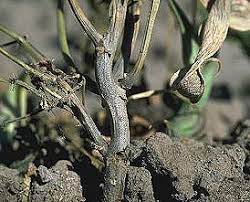
Ashy stem blight is a common disease that affects Dolichos bean (Arka) crops. The disease is caused by the fungus Phomopsis vexans, which can infect the stems, leaves, and pods of the plant.

Symptoms of the disease include brown or black lesions on the stem, which can cause the stem to become brittle and break easily. The leaves may also develop yellow spots, and the pods may become discolored and deformed.

To control the spread of the disease, it is important to implement proper cultural practices such as crop rotation, removing infected plant debris, and avoiding overhead irrigation. Additionally, fungicides can be applied to help control the spread of the disease, with thiophanate methyl and vitavax reduced incidence significantly. Treating the seeds with captan, thiram or benlate is also helpful in reducing the disease( usually 3g/kg og seeds). Organic control implement by treating the seed with biocontrol agents like Trichoderma viride, Pseudomonas fluorescens and Bacillus subtilis show the results. 

What is Horticultural Oil?

Horticultural

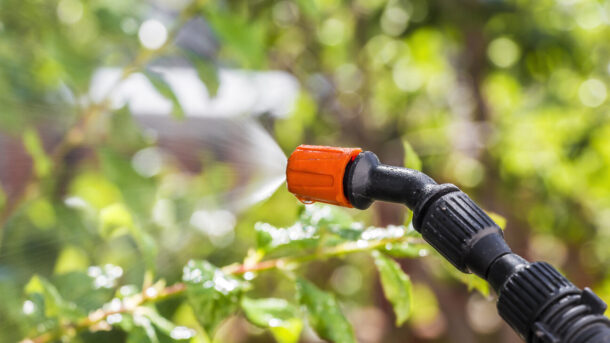
Horticultural oil is a type of petroleum-based or mineral oil that is used in horticulture and agriculture to control pests, diseases, and mites on plants. It works by smothering the insects and their eggs, and it can also help to control certain fungal diseases by removing the waxy surface layer of fungal spores, reducing their ability to spread. 

Horticultural oils are highly refined and are considered safe for use on plants, but care should be taken to follow the label instructions for dilution and application to avoid damaging the plants.

Treatment of four spotted fall armyworms in Sweet  corn.

armyworms

Control of Four-spotted Fall Armyworms can be achieved through a combination of cultural, biological, and chemical methods. Cultural methods include crop rotation, removal of crop residue, and planting of early-maturing varieties of maize..

  • Apply neem cake @ 250 kg/ha at the time of new sowing of the crop in soil. Install one light trap in the field. 
  • Do not take maize after maize crop. Follow crop rotation. 
  • Collect & destroy the egg masses mechanically. 
  • On initiation of the infestation, spray neem base formulation @ 40 ml (1500 ppm) to 10 ml (10000 ppm) per 10 liter of water.
  • On higher incidence, spray chlorpyriphos 20 EC 20 ml or spinosad 45 SC 3 ml or emamactin benzoate 5 SG @ 4 g or chlorantraniliprole 18.5 SC 3 ml per 10 liter of water. See that leaf whorl should be properly covered with spray.

In addition to these control measures, farmers can also take steps to prevent the spread of Four-spotted Fall Armyworms. This includes regularly scouting their fields, early detection and reporting of infestations, and avoiding the movement of infested plant material.

It is also important for farmers to be aware of the potential for insecticide resistance and to implement integrated pest management strategies to minimize the risk of resistance development. 

Invasive pest ( Four spotted fall armyworm) in maize crop

Invasive

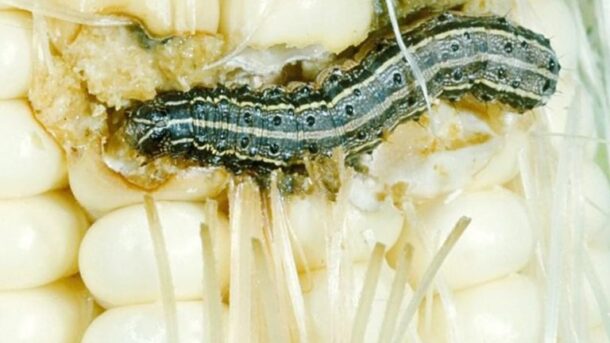
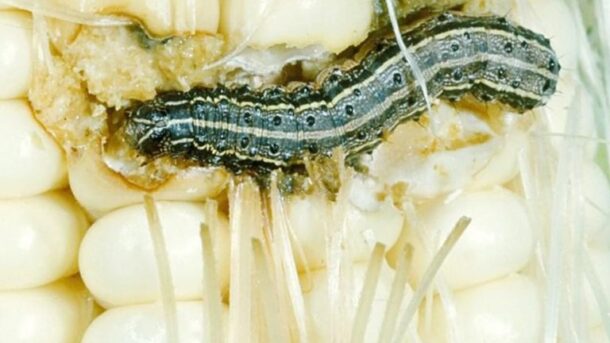
The Four-spotted Fall Armyworm (Spodoptera frugiperda) is a highly invasive and destructive pest of maize (corn) crops. This caterpillar is known to feed on the leaves, stems, and ears of maize plants, causing extensive damage to the crop and reducing yields. In severe infestations, the pest can completely defoliate plants and even destroy entire fields.
The larva is brown in colour, dark pimple-like spots with hairs. Larval stage is about 12 to 20 days. This invasive polyphagous pest lays their eggs on the lower surface of the leaf in a bunch covering with silken thread. Young larvae scrap the epidermal layer of the leaf and feed chlorophyll contents. Bigger larvae feed on leaves by making uneven shot holes on the leaf and also enter into the cob and feed the developing grains. Saw-dust like excreta is seen near the leaf whorl. This caterpillar can do 34 to 50% damage to the maize crop.