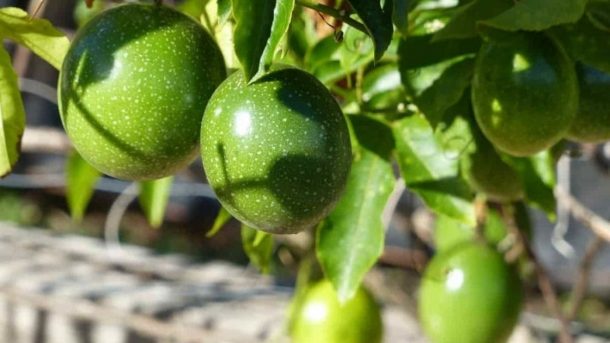
Yellow passion fruits are suitable for tropical regions, while purple passion fruits require sub tropical conditions. It grows to an altitude of 2100 meters and the rainfall is 1000 to 250 meters. The ideal temperature is 20 °C to 30°C to get the best yield. The cool temperatures in purple passion fruits are conducive to the onset of flowering and fruit set and the high temperature and quality required to promote juice production.
ScientificFarmingWeb
How Site selection is done for passion fruit growth?
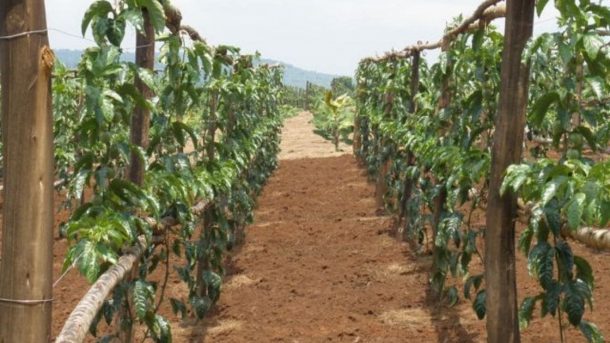
Passion fruit vines will grow quite long and may need help for the best results. The ideal place for growing vines is loose, fertile soil with at least 8 hours of sunlight per day. This soil should have a lot of organic matter for good drainage and strong root growth. A southern exposure or dappled shade is preferred, but the vines will withstand the full sun if protected from the wind. However, growing passion fruit vines in hot areas should be avoided as it can damage them.
What are the advantages of High-Density Peach Planting?
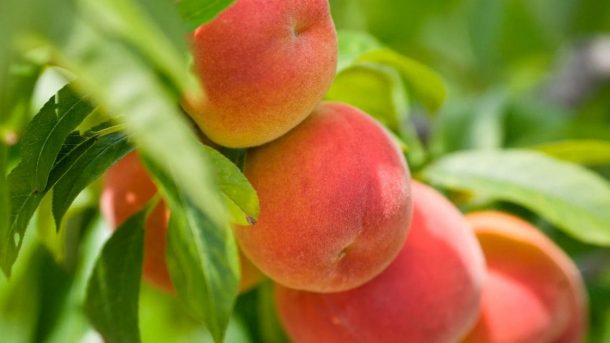
Here, I mentioned the few reasons why to consider high density planting. The main benefit of high-density planting is that you can plant multiple varieties in a small space. Low cost per unit production, Allows mechanization in fruit crops. Improved fruit yield and quality. Efficient use of applied and natural resources. Induces precocity, increases crop yield, and also improves fruit quality. Enables the mechanization of fruit crop production. Best utilization of land and resources with high-density planting ensures quality fruit production and increased yield per unit area. Easy for intercultural, plant protection, and harvesting. Obtain export quality of the harvest. It is amenable to modern inputs application methods such as drip irrigation, fertigation, mechanization. Early economic returns.
How Fruit Thinning is done in High Density Peach Planting?
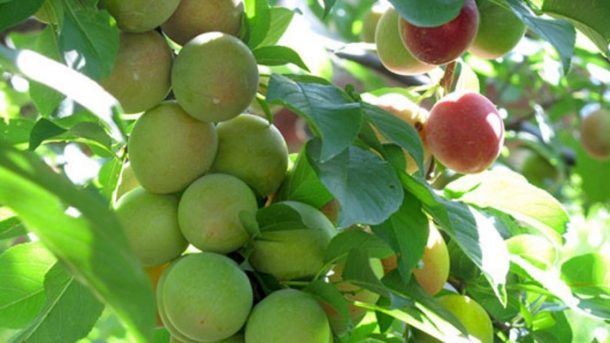
Fruit sets can be too heavy on some trees in some years. If Peach fruit is not thinned, the size, color and quality of the entire crop are reduced. Peaches usually have excess fruit. In years without freeze damage, more Peach fruits will set than the tree can support, and the fruit must be thinned. Normally, fruit thinning will allow the remaining fruits to develop optimum size, and color, as well as prevent depletion of the Peach tree.
What is the irrigation Requirement in High Density Peach Planting?
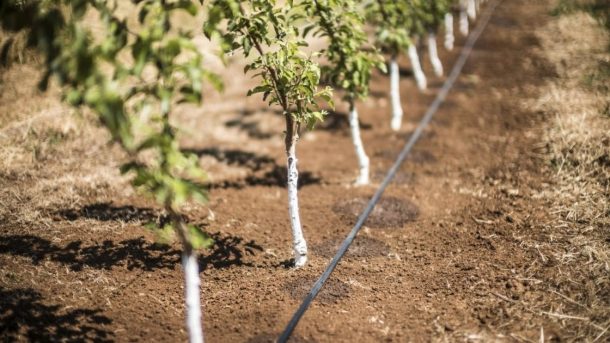
After planting the Peach trees, irrigation should be given immediately. In the rainy season, these peach trees may not require watering. The drip irrigation system is the best method for the effective use of water. Irrigation must be given at some critical stages, in case of a dry spell. Watering is very important at the flowering/budding stage and fruit development stage.
How Weeds are Controlled in High Density Peach Planting?
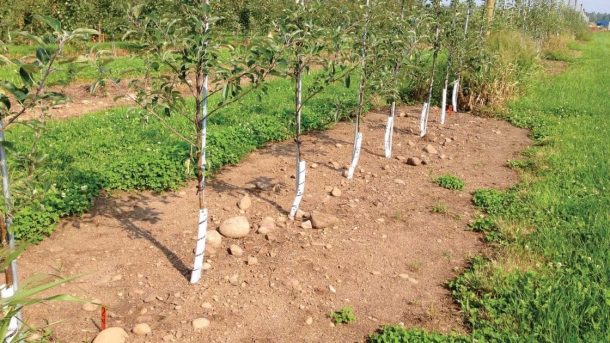
These are regulated by manual weeding however it is tiring and also expensive. As Peach roots are irregular, they can be damaged by continual ploughing. Thus, the usage of herbicides is an excellent substitute.
How Training and Pruning is done in High Density Peach Planting?
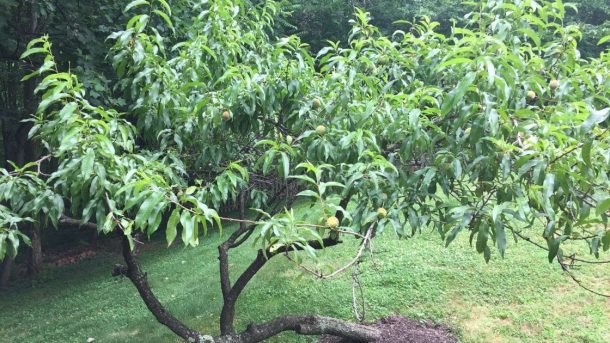
Training and pruning are effective tools in high-density peach planting for shaping and controlling tree size. The training in Peach trees begins when the tree is first planted and continues throughout its productive life. Each plant is allowed to maintain a single stem with upward growth up to 60-80 cm and then 4 scaffold branches are allowed in 4 directions to make the tree frame. After the start of bearing, shoots arising from secondary and tertiary branches are given 15 to 20 cm deep pruning soon after Peach fruit harvest. A spray of 1% urea combined with 0.2% Blitox-50 must be done soon after tree pruning.
In the perpendicular-V system, only two main limbs oriented perpendicular to the tree row is allowed to develop. The advantage of the perpendicular-V system is that trees can be planted closer in the row to increase the number of trees per acre. In Peach Planting, peach trees are usually trained to an open center system for optimal growth. Cut back newly planted trees to about 30 inches high, just above a lateral branch; and select 3 to 4 laterals with wide angle crotches spaced evenly. The peach tree requires heavy and regular pruning because fruiting occurs laterally only on the previous season’s growth. During early bearing, 20 to 30% linear growth of the shoots should be removed. The best time of pruning Peach trees is the last week of October.
How High-Density Peach Planting is done for Limited Spaces?
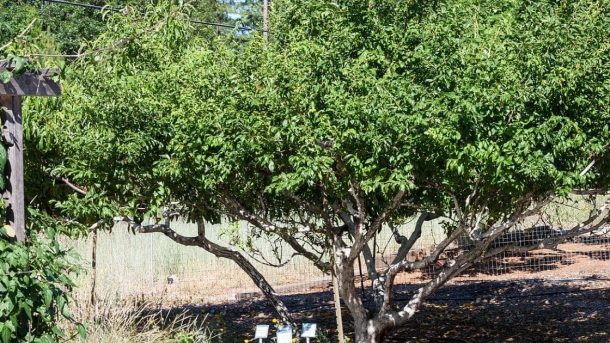
Fruit trees can be planted very close in high density planting. There are many ways to plant in a limited space and will depend on the desired look of the orchard. Multiple trees planted close together in the same hole. Trees planted close together to practice a hedge. Trees trained as an espalier to grow along a narrow area. To evaluate the potential offered by high density planting application, it is necessary to take into account tree size control, and also the training system most suitable to obtain high crop yield and good fruit quality. The main tools for tree size control are rootstocks, summer pruning, root restriction, growth regulators. Also, the main Peach-growing countries of the world, to investigate the extent of utilization and the main aspects characterizing Peach and nectarine HDP orchards, are summarized.
The training systems for HDP are Fusetto, Tatura trellis with their interaction with soil fertility. Fusetto allows a maximum planting density of 1200-1500 trees per hectare. It is necessary to adopt some training systems in extremely fertile soil. The first alternative (palmette) allows maximum planting densities of about 700-900 trees/ha. For orchards with planting densities greater than 1000-1500 trees/ha, the Tatura trellis and its variants appear the most appropriate. The right choice of training system will have to be made based on careful economic analysis, taking into account the greater costs involved for the establishment and also for the management of HDP.
What is the nutritional Requirement for High Density Peach Planting?
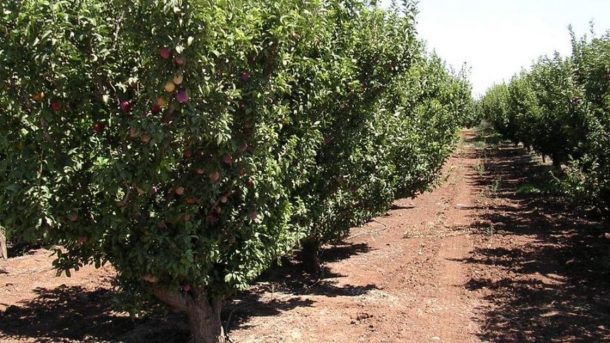
The nutritional requirement of Peaches is higher compared to other stone fruits because it bears on one-year growth making the production of annual growth imperative for fruit production. Also, recoupment of the wood removal every year in pruning is necessary.
Fertilizers are applied every year. A multitude of factors, including soil type, fertility, climate, cultivar, planting density, shoot growth, and irrigation, affect nutritional requirement and fertilizer application in peach orchards. The FYM (farmyard manure) along with a full dose of P and K must be applied during December and January. Half dose of Nitrogen is applied in spring before flowering and the remaining half dose a month later.
What is the Spacing Requirement for High Density Peach Planting?
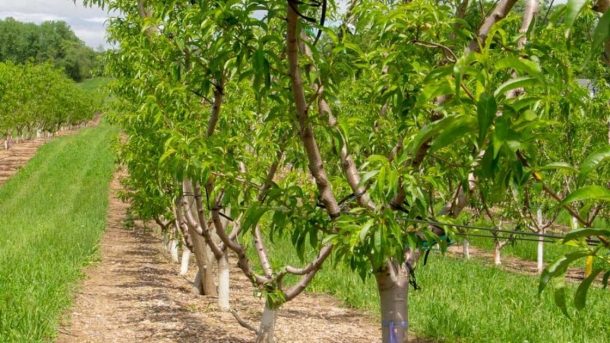
In high density plantation system, the distance can be reduced to 3 mx 3 m. In the Tatura trellis and Meadow system, the peach tree is planted at a distance of 5 mx 1 m (2000 plants/ha) and 2 m x1 m (5,000 plants/ha) respectively.